Q&A with Abdullah Al Bahrani, Founder of Decode Econ
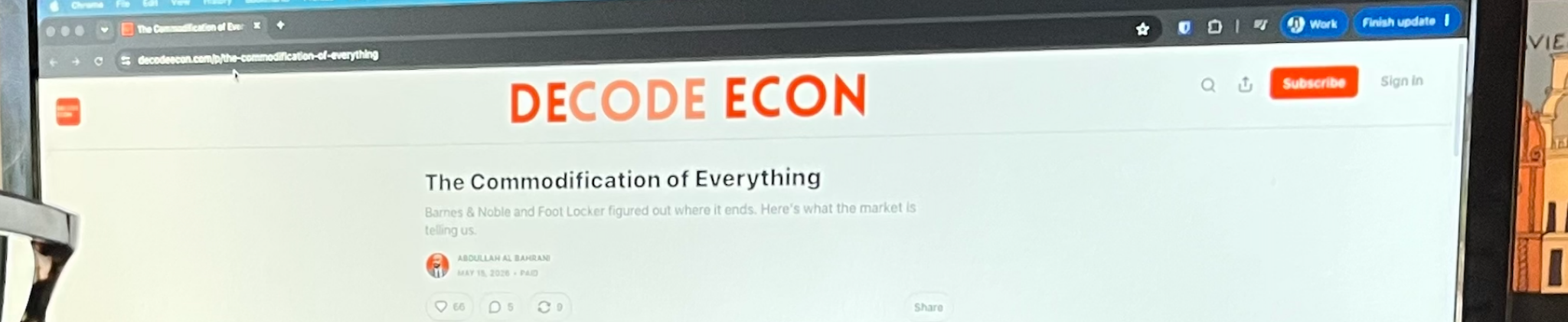
We connected with Abdullah Al Bahrani, economist and Associate Dean of the Haile College of Business at Northern Kentucky University and creator of Decode Econ, to talk about what makes economics click for students, why personal finance and economics belong together, and what he wishes every teacher knew on the morning of their first class.
You worked in the mortgage industry during the housing boom. Does that still show up in the way you teach?
I learned that making optimal choices and long-term decisions is difficult. Whether it's behavioral aspects or incomplete information, people make economics and personal finance decisions under difficult circumstances. The messiness of the decision making process is often missing in economic textbooks.


What should teachers know about where an economics education leads?
Teaching the models is necessary, but find ways to get students to explain, present, and use what they are learning to express what is happening in the economy and their own lives. It will help them realize when the models do a good job and when they might fail. Also, it will allow them to question assumptions. Most importantly, it would make the content more relevant to them.
Decode Econ is built on economics empowering people rather than intimidating them. Where does the intimidation come from, and how do you get past it?
The intimidation comes from leading with the vocabulary. Economics is a new language for describing things students already know.
When I teach introductory courses I tell students they are learning a new language to express what they already know. However, economists often lead with the complex language of economics to audiences that have never heard it before. It makes them feel like they are on the outside and can't join the conversation. Our goal is to bring more people into the conversation. It also allows us to hear from them. The better the dialogue the more improved our output is.
Your programs emphasize community and learning alongside each other. What does a classroom look like when that is working?
Be intentional about your energy, your examples, and your follow-up questions. The goal is for every student to feel seen.
The best example of our community building is how we work with undergraduate students, amplify them, and help them see how they are growing through working at Decode Econ. Classrooms are no different. Educators should be intentional about how they manage the classroom, what examples they use, and what students are watching.
In a recent podcast with Claire, one of the research assistants at Decode Econ, she mentioned that she knew my class was going to change her life in the first lecture. She said the energy I brought to the classroom made her see the passion I had for the subject. Most importantly, when she answered a question, I followed up with another one directly, which led to a conversation after class. As she said, she "felt seen." Be intentional about having your students "feel seen."
Every Decode Econ piece ties the story back to the reader's own decisions. How could that structure translate into the classroom?
Students want to know what you make of the material and what they should do with it. The college ROI question is a live example.
The Bottom Line has recently been replaced with "Dr. A's Take." Just like in the newsletter, I realized that students in my class want to know how I make sense of this content, and what they should do with what they just learned. Principles of Macroeconomics, which is the intro course that I mostly teach, should connect with the news easily. However, it can also connect with job search, workforce readiness (structural unemployment), and how to adjust your personal behavior to the changing economic landscape.
A great current example is the conversation around higher education return on investment. If you are teaching high school, your students and their parents are asking if college is worth it. We all know it is, but the ROI is lower today than it has been for a while. The reason is because we have a strong labor market. It is easy to find a job. As that market changes, the ROI on higher education will return. New technology, like AI, complicates this conversation but we know from the data that the lifetime earnings of college graduates is much higher than those who did not attend college.

How do you decide which stories are worth tackling from week to week?
We write daily, sometimes several times a day. We post it on LinkedIn, Instagram, and create shorts on TikTok, Instagram, and YouTube. We are pushing out a lot of content. The newsletter goes out with our top posts, or deeper conversations. How we decide what we talk about is based on what we find exciting or what we believe the audience might need to learn about. Our audience often shapes our content either by asking questions or sharing information with us that they want decoded. We write for our community, and to share our economic knowledge for the greater good.
High school economics often carries the personal finance load too. How does economics support personal finance education?
Personal finance is economics! I wish more people did not present these subjects as substitutes but as complements. Personal finance is applying economic thinking to your personal financial decisions. A good understanding of economics helps you improve your personal finance outlook.
I understand that high schools can teach only one course and have to choose between economics and personal finance. I think, and am working on a project, to help teach personal finance with economic thinking. I believe if you teach personal finance without an understanding of the economy, and how it can change, you only teach rules for people to follow. As the economy changes or policies shift, they aren't able to adjust because they did not learn the economic foundations.
Where in Decode Econ should a high school teacher start?
I would recommend that they watch the "Why study economics" video and newsletter. I would also share what we get wrong about personal finance education.
What tools and data sources would you recommend to a high school teacher?
The Journal of Economics Teaching, Marketplace, and Planet Money. The bigger point is to pick the community that speaks to you and join in.
Journal of Economics Teaching (JET) is a great resource for innovative teaching ideas. I would also recommend the JET conference, which will be in Spokane, Washington next summer. I listen to, and am a guest at times, on Marketplace radio. I am a huge fan of the Planet Money podcast too.
There are so many great resources, and they are increasing. I started in 2020 because at that time there wasn't an educational resource for educators teaching economics online due to COVID. Since then, there has been a drastic change. Find the entity that speaks to you and join the conversation. At Decode Econ we want to hear from you and be a resource to you and your students.
What would you say to a teacher on the morning of their first economics class?
You do not have to teach economics the same way you were taught it. Find your voice and express your passion.

Ready to make economics click for your students?
Become an Econiful member for free access to all 80 lesson plans, professional development resources, and live events with economists like Abdullah Al Bahrani.