
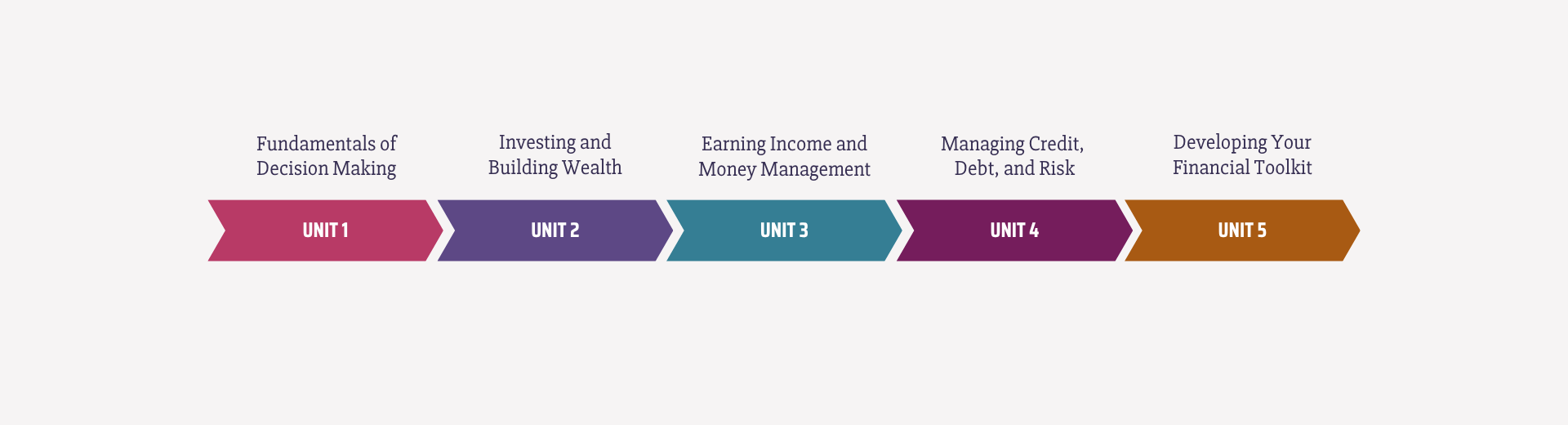
Unit 1 introduces high school students to the foundational concepts of personal finance, including decision making under scarcity, the principles of economic thinking (cost-benefit, opportunity cost, marginal, and interdependence), goal setting, and the cognitive biases that shape financial choices.
How to use this unit
Lessons build on one another and are designed to be taught sequentially. They can also be used as standalone lessons.
New to Econiful?
Visit the curriculum overview to explore both courses and all lessons.
Become a member
Unlock all lessons with a free Econiful membership ↗
Related economics unit
Teaching economics too? See Unit 5: Personal Finance

1.1 Semester Pre-Assessment
Our personal finance pre-assessment is currently under development and will be published soon. Become a member to access all other lesson plans and to receive updates about new lesson releases!

1.2 Scarcity and Choice: Designing Your Living Space
Designing a shared living room within a budget, students learn how the principles of economic thinking, especially scarcity, guide decision making.

1.3 Your Decision-Making Toolkit: Part 1
Students are introduced to the cost-benefit and opportunity cost principles of economic thinking and practice applying each to real-life decisions, including their own choices from the Lesson 1.2 activity.

1.4 Your Decision-Making Toolkit: Part 2
Building on Lesson 1.3, students complete their decision-making toolkit by learning the marginal and interdependence principles and practice applying all four principles together to new scenarios.

1.5 Setting SMART Goals
Students explore the research on why goal setting matters, learn the SMART goal-setting framework, and write a SMART goal of their own.
Membership required for the full lesson materials.

1.6 Understanding Cognitive Biases: Part 1
Through a quick, no-stakes questionnaire, students experience four cognitive biases firsthand, then define each one and see how they can quietly shape personal finance decisions.
Membership required for the full lesson materials.

1.7 Understanding Cognitive Biases: Part 2
This personal finance lesson is currently under development and will be published soon. Become a member to access all other lesson plans and to receive updates about new lesson releases!

1.8 Future You Part 1: Economic Thinking, SMART Goals & Cognitive Biases
This personal finance lesson is currently under development and will be published soon. Become a member to access all other lesson plans and to receive updates about new lesson releases!

1.9 Assessment Preview
To prepare for the Unit 1 summative assessment, students preview the task and rubric, then apply the rubric to score sample responses before writing their own.
Membership required for the full lesson materials.
1.10 Using Economic Thinking to Make Better Decisions
Students complete a summative assessment in which they apply two principles of economic thinking to advise a friend facing a decision and recommend a SMART goal.
Membership required for the full lesson materials.
