Q&A with Benjamin Shiller, author of AI Economics
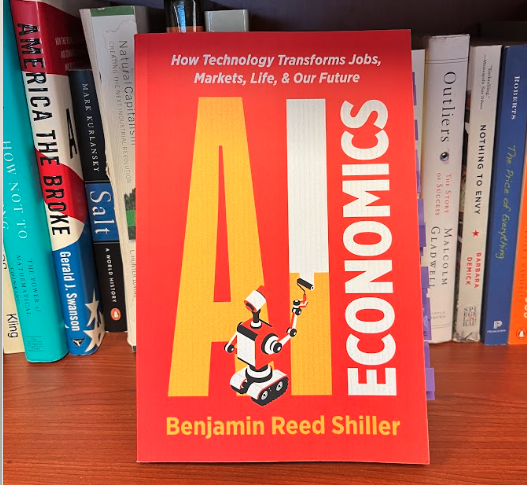
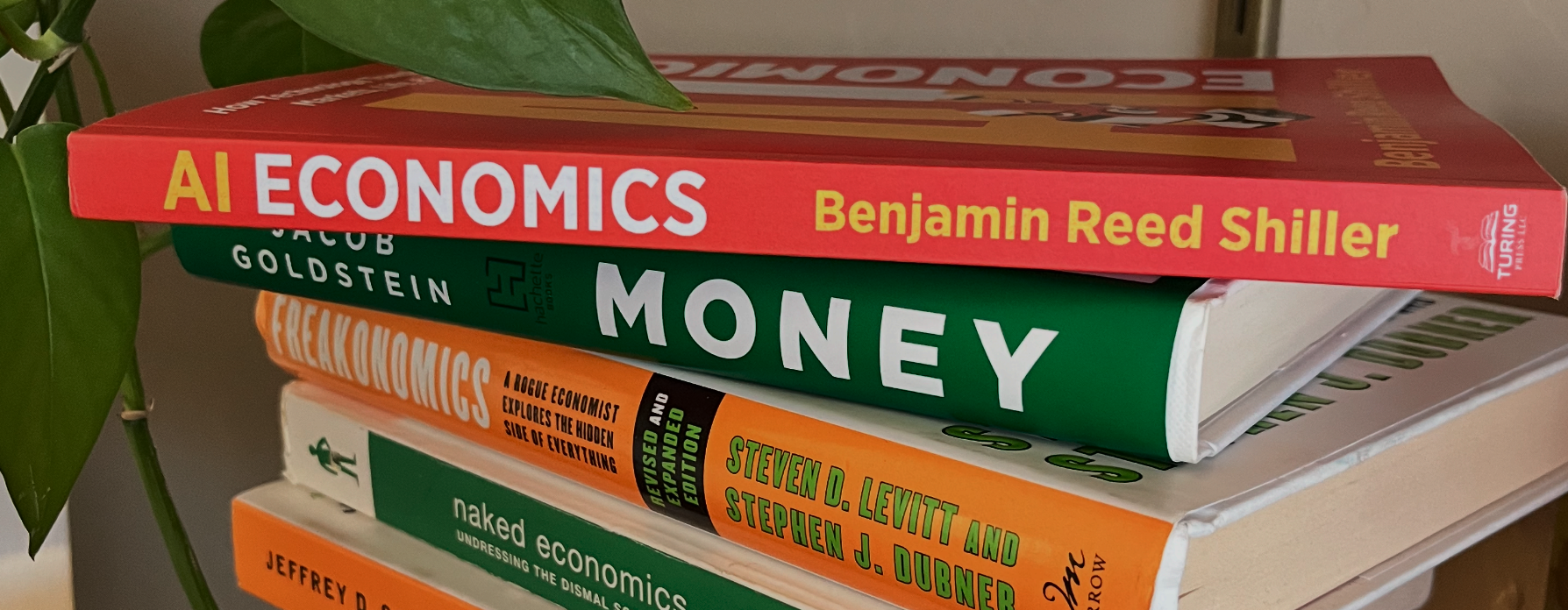
We connected with Benjamin Reed Shiller, economist at Brandeis University and author of AI Economics: How Technology Transforms Jobs, Markets, Life, & Our Future (2026), to talk about what an economic lens reveals about AI and why it matters most for high school educators right now.
What sparked AI Economics? Was there a specific moment that told you this was the book you needed to write?
Economists and technologists had opposite blind spots, and nobody was bridging them for a general audience while the window was still open.
The first was with Imke Reimers, my longtime coauthor. We were debating whether AI was actually going to be transformative, and, more practically, whether it was already useful for the kind of research we do. I came away struck by how much skepticism still ran through academia. It reminded me of when Imke and I started a paper on self-driving cars years ago and had to keep convincing renowned academics that the topic was even relevant.
The second conversation was on the other side of the aisle, with technologists. They had the opposite blind spot. They could tell you in vivid detail what a model could do, but they paid almost no attention to whether companies were actually incentivized to deploy it, or how labor markets, prices, and institutions would mediate the impact. Geoffrey Hinton's "stop training radiologists" line (because AI would take their jobs) has been wrong for a decade now. It was the canonical version of this mistake, and I kept hearing softer versions since then.
What hit me was that the bookshelf reflected exactly this asymmetry. After ChatGPT's release, the prominent AI books were overwhelmingly written by technologists. The economists who had spent two decades at small, technical conferences quietly figuring out how digitization actually reshapes markets weren't getting enough attention. I felt it was crucial to relay what we'd learned for a wider audience, and to do it while the window for shaping how people think about this transition was still open. I also wanted the book to be genuinely fun to read, because a book that doesn't get finished doesn't help anyone.
Why is economics essential for understanding AI?
Technological capability alone doesn't tell you what will happen. Everything has to pass through the incentive filter: prices, wages, demand, substitutes, and human choices.
History is full of dazzling technologies with modest impact and modest technologies with enormous impact. Radiology is one example; the book walks through many more. When economics is left out of the AI conversation, you get the kind of confident, capability-based predictions that have been wrong for a hundred years.
With economics, you can ask the better question: given how incentives actually work, which jobs, prices, and institutions will move — and which won't?
Will AI finally pop the tuition bubble?
The first-order effect probably won't be cheaper tuition. Instead, expect schools to use AI to raise the bar on what students actually learn.
AI may be the first technology since the printing press that can deliver meaningful productivity gains in teaching, finally offering a way to address Baumol's famous "cost disease." What's shifted since I finished the book is what I think those gains will be spent on. History suggests an under-appreciated pattern. Accounting software was supposed to thin out accountants; instead, it lowered the cost of bookkeeping enough that vastly more businesses started keeping proper books, and the profession expanded. ATMs were predicted to put bank tellers out of work; instead, cheaper branches meant banks opened more of them, more people got banked, and teller employment actually grew for decades afterward.
When the price of something useful falls, we often consume dramatically more of it rather than just pocketing the savings. I now think education is heading the same way. I no longer expect the first-order effect to be tuition relief. Instead, I expect it to be a sharp rise in how much students actually learn. The teachers and institutions that thrive will be the ones learning right now how to direct AI rather than compete with it, because they'll be the ones setting that new, higher bar.
AI has been appearing in classrooms for a couple of years now. Where are you seeing AI as most useful for teachers?
The next few years will produce the largest gains in student performance in living memory, especially for teachers who embrace AI rather than compete with it.
Teaching has faced the same problem for two thousand years: a classroom of students with different backgrounds, speeds, and styles, and one human who can't be in fifteen places at once. AI finally cracks the one-size-fits-few problem. It can personalize endlessly and never gets tired. A student conveyed this idea perfectly, in a paper evaluating where AI belonged in their education:
"In linear algebra, I never understood the material and felt like the teacher was only teaching in 'math language.' For the week leading up to my midterm, I stopped going to class and relied entirely on slides and ChatGPT. I learned more in that week using generative AI than I did in two months in that class, thanks to the AI's individualization and accessibility. For certain concepts I had trouble grasping, the AI taught me through analogies like cooking and basketball... I scored 10 percentage points higher than the class average on the midterm."
But that same story is telling us why the human teacher is more important, not less. The teacher's ability to convey the core concepts and explain why they matter is as crucial as it ever was. Likely more so, because AI finally frees teachers from the impossible task of pitching the lesson to every background, learning style, and learning speed at once. That work can now be handled, patiently and conveniently, by an AI tutor that helps each student fill in the gaps with a personalized style and pace. The teacher's time is freed for the most important tasks: setting the standard, building the intellectual community of the classroom, modeling the discipline, and asking the questions the student didn't know to ask. I've already seen the shift firsthand: students show up to my office hours less often for routine questions and more often with deeper ones. I'm convinced AI (used well) will be a tool that augments teachers, at least the ones who learn to use it synergistically.
For high school economics teachers specifically, I think AI is the gift case study of this generation. Many concepts in a standard econ curriculum (incentives, labor markets, comparative advantage, externalities, Baumol's cost disease, network effects, monopoly, price discrimination, prisoner's dilemma) have vivid, current AI examples students are already living through. They are encountering this technology every day, yet very few have a strong framework for thinking about it. AI Economics is written to give them that framework in language they'll actually engage with, and to give teachers a way to make abstract concepts feel like the most relevant material in school.
How can studying economics help high school students think about careers?
The most valuable skill economics gives a young person right now is the ability to look past confident predictions and ask better questions.
Technological capability doesn't replace jobs; companies replace jobs when the financial math works. A technology can be jaw-dropping and barely move employment; another can be modest and reshape an entire industry. The book walks through the concepts that determine which is which, including what I call the weirdness wage premium: the way idiosyncratic, niche human skills become more valuable, not less, as firms rationally use AI to scale up only the standardized ones in large markets. A student who understands this doesn't choose a career by reading headlines. They can look at a profession and reason about it: what's the substitution risk, what's the augmentation upside, and so on. That's a lifelong skill, and it's the one I most want students to leave with.
What do you hope teachers walk away with after reading AI Economics?
Two things: a book they're excited to hand to students, and a concrete set of tools they can use immediately in the classroom.
First, a book they're excited to hand to students, one that treats economics not as abstract theory but as the live, indispensable framework for understanding the most important transition of our lives. Second, a set of concrete tools their students can use immediately: the ability to push back on overconfident predictions, to evaluate a career through an economic lens rather than a hype cycle, to recognize what actually determines whether a technology reshapes an industry, and to see the future as shaped by incentives and human choices rather than technological destiny.
If a teacher closes the book thinking my students need to read this, and I now have better answers when they ask me what's going to happen — that's the win.

Ready to bring AI Economics into your classroom?
Become an Econiful member for free access to all 80 lesson plans, professional development resources, and events like this Summer Book Club.