
Q&A with Jacob Reed, Founder of ReviewEcon & EconRocks
We connected with Jacob Reed, AP economics teacher and creator of ReviewEcon.com and EconRocks, to talk about teaching a subject you were assigned rather than trained in, what makes a review game actually work, and why the first thing a new economics teacher needs is permission to be patient with themselves.
How did you find your way to economics, and what made you start sharing your materials with other teachers?
Like many social science teachers, I was "voluntold" to teach economics. While I took three econ classes in college, history was definitely my focus. Although economics wasn't a primary area of study in college, I quickly fell in love with teaching it. Not only did I find it incredibly interesting, my students did as well. There are so many fun activities, games, and lessons that bring economics to life.
I started sharing my work with others when I realized there was a need I could fill. When I made materials for my own class and students, I found I wasn't the only one looking for similar materials. So, I spent extra time on them to make them a bit better and more accessible to other educators. I am excited to see that my work has benefited students outside my own classroom.
You answer a lot of questions from teachers who feel in over their heads with economics. What do they usually need to hear?
Their worries are reasonable, and the subject does get easier. Most teachers end up loving the class they were nervous about.
My number one piece of advice for teachers just starting out with economics is to be kind to yourself. If you are a social science or history major, there is a solid chance you haven't taken much economics. The subject is unlike anything else, and the ways of thinking are not always intuitive at first. But I promise those teachers, it will get easier, and if you give it time, you will come to love being an economics educator. The message I try to send is an acknowledgement that their concerns and worries are reasonable, but that they can absolutely master the material and it will ultimately become a class you don't want to give up.
ReviewEcon leans on games and practice rather than lecture. What separates a review game that works from one that doesn't?
Immediate feedback is what makes a review game work, because it catches a misunderstanding before a student practices it into habit.
Before creating ReviewEcon, I would give my students problem sets to practice for homework. Then, when going over the answers, I realized many students had practiced incorrectly, flipping fractions on comparative advantage calculations, confusing quantity demanded with demand, and so on. We didn't have time to adequately fix the misunderstanding and practice correctly, so I created online review games, inspired by the work of Steve Reff of Reffonomics, and created ReviewEcon to help my students practice with immediate feedback. That feedback helps students recognize and correct their errors and misunderstandings more quickly.
I believe a good review game is specifically focused on a skill or concept that students really need to know and is set up to challenge student assumptions and thinking. The most important aspect, in my opinion, is the immediate feedback. When a student is incorrect, it is important to diagnose and correct the misunderstanding as quickly as possible so students don't spend too much time repeating the error. As a result, many of the questions in my review games focus on commonly made errors.

Are there concepts students hit a wall on every year, and what finally gets them over it?
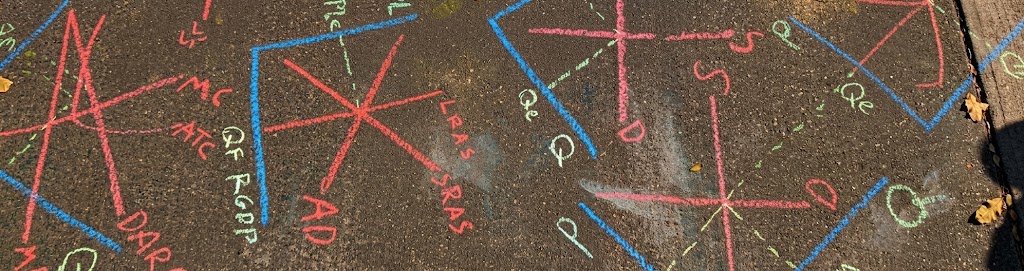
In AP Economics, that's most of Unit 3 in Micro [Production, Cost, and the Perfect Competition Model]. The math and graphs make kids' heads spin. I get kids through it with a lot of fun practice to break up the monotony. Practicing on whiteboards, playing Kahoot or Blooket, getting sidewalk chalk and drawing on the walls of our handball courts, and working in groups to help kids work through the difficulty through discussion.
You teach U.S. history alongside economics. Does teaching both change how you teach either one?
While teaching history, I definitely emphasize the economics of policies and historic events a bit more than I otherwise would. I also bring in some history to my economics classes as well. One of my favorite lessons, a variation of a lesson from Sarah Jeynk at Youngstown State University and Daniel Wakefield at Ohio Connections Academy, is about how different aspects of WWII can be shown on the production possibilities curve. Connecting this abstract model of the economy to history students already know makes the PPC so much clearer for my students.
If a teacher has one hour a week for ReviewEcon and EconRocks, where should they start?
Start with the CED alignment in the ReviewEcon teachers tab, then the review games. EconRocks songs are being sorted into playlists by AP unit.
On ReviewEcon, I would advise teachers to start with the CED alignment for Micro and Macro found in the teachers tab. There, all of the resources are listed by AP topic. Personally, I expect most teachers will get the most value from the games. I assign the games to my students and have them submit screenshots of their final score in Google Classroom.
As for EconRocks, I am putting the songs in playlists based on the AP CED units to help AP teachers find topics more quickly. When I finish, I plan to make an on-level playlist as well. For now, I am playing the music before and after class, with captions on, as a fun way to reinforce lessons from previous days. I could see using these as warm-ups with questions about the song, or as longer lessons, but I haven't done that yet.
What tools and data sources would you recommend to a high school teacher?
For economic data, it doesn't get better than FRED from the St. Louis Federal Reserve. I use it often in and outside of class. For lesson ideas, there are a lot of great resources out there. Econiful obviously has great lessons, but I also get great ideas from the Foundation for Teaching Economics and the AP teacher resource book from the Council for Economic Education.
What would you say to a teacher on the morning of their first economics class?
Are you starting with the Packing for a River Trip lesson from Econiful? It's great. I would also advise a new teacher to focus on the impact of economics on the individual students' lives. Students really like economics when they see how much of it is about them, personally.

New to teaching economics? Start here.
Become an Econiful member for free access to all 80 lesson plans, professional development resources, and live events with educators like Jacob Reed.