
Packing for a River Trip: An Introduction to Economics
Unit 1 · Lesson 1.2 · Last updated April 15, 2026
A 45-minute hands-on lesson using a Grand Canyon rafting scenario to introduce scarcity, trade-offs, and the principles of economic thinking — no economics background required.
Overview
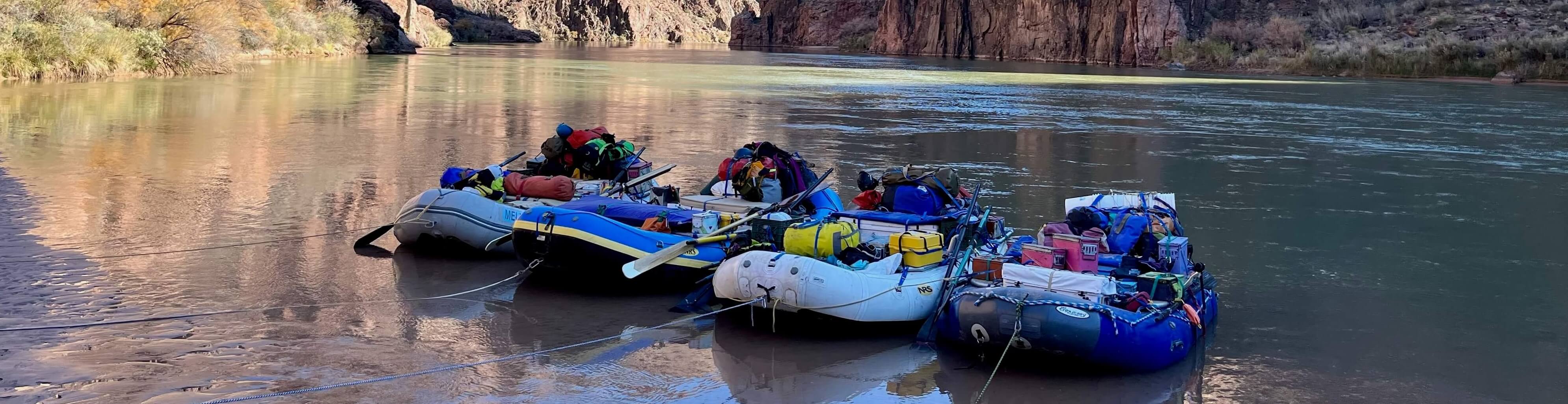
In this lesson, students will plan for a two-week river trip to learn how the principles of economic thinking are central to all decision making. Following the primary activity, students will be guided through a debrief to introduce them to economic vocabulary and the principles of economic thinking. These principles will be explored in more depth in Lesson 1.3 and Lesson 1.4 and will be used throughout Unit 1.
Curious about the thinking behind this lesson? Teachers who want the pedagogical reasoning behind this lesson can read our note in the Journal of Economics Teaching.
Learning Objectives
- Explain the role scarcity plays in decision making.
Materials
- Instruction Slides (display during class period)
Paper Option
- Student Handout (1 copy per student)
- Raft Handout (1 copy per pair)
- Optional: Additional River Trip Information (educator reference)
Electronic Option
- Electronic Student Handout (1 editable copy per pair)
- Computer with internet access (1 device per pair)
- Optional: Additional River Trip Information (educator reference)
Lesson Sequence
Slides 1–3
- Display Slide 2. Place students into pairs. Students discuss the opening prompt with their partner, then share with the class.
- Proceed to Slide 3. Introduce the learning objective: students will connect decisions about a multi-day river trip to the concept of scarcity and economics broadly.
Slides 4–9
- Progress through Slides 4–5 for an overview of the primary activity.
- Advance to Slide 6. Distribute Student Handouts. Read the introduction aloud. Pro Tip: tape off a 20-square-foot area on the floor to help students visualize the space.
- Proceed to Slide 7. Explain raft-packing expectations. Gear can be split on the grid but must represent the correct square footage.
- Display Slide 8. Read the Instructions section aloud, pausing between sections for questions.
- Advance to Slide 9. Allow 15 minutes for pairs to complete Steps A–B and begin Step C. Circulate and note which pairs debate items — these make excellent debrief call-ons.
- After 15 minutes, move to the debrief even if Step C is incomplete.
Slides 10–21
- Slides 10–11: Open the debrief. Ask students to share responses to Slide 11.
- Slide 12: Define scarcity as the central focus of economics. Students add notes to the Debrief section of their handout.
- Slide 13: Reinforce that economics is directly relevant to the packing task just completed.
- Slides 14–15: Discuss the cost-benefit principle — how students weighed the value of each item against the space it required.
- Slides 16–17: Introduce the marginal principle — how decisions about packing one more of something reflect incremental thinking.
- Slides 18–19: Define opportunity cost — what each pair gave up by choosing one item over another.
- Slides 20–21: Describe the interdependence principle — how packing one item affected choices about others.
Slides 22–23
- Progress through Slides 22–23. Pairs confer on the closing questions, then discuss as a class.
- Pro Tip (paper option): Collect Raft Handouts and display them around the room as a visual reminder of the four principles throughout Unit 1.
Aligned Standards
Voluntary National Content Standards in Economics
What Educators Are Saying
I love that it gets kids thinking creatively. It's a great introduction to comparing wants vs. needs and even opportunity cost. The kids have to make sure they're taking the things they'll need while comparing the utility of some items over others. They deal with opportunity costs and choice without even realizing it until the debrief.
The lesson was engaging and got the most difficult students involved too. This was an excellent lesson to preview the curriculum and to get students thinking like an economist.
The lesson was engaging and got the most difficult students involved too. This was an excellent lesson to preview the curriculum and to get students thinking like an economist.