
Introduction to Firms
Unit 2 · Lesson 2.3 · Last updated June 2026
A 45-minute simulation where student groups run competing hat firms, weigh costs and benefits, calculate total revenue and profit, and develop the supplier mindset they'll need for the law of supply.
Overview
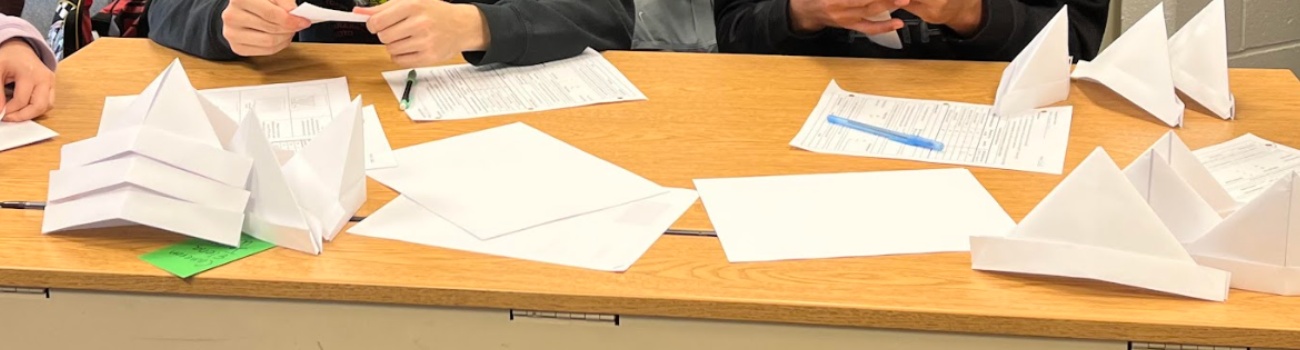
In this lesson, students work in groups of 3 to 4 to run a Hat Firm and compete to earn the highest profits. Firms weigh the costs and benefits of their decisions and calculate total costs, total revenue, and profit. This lesson is intended to be used after students have been introduced to product markets (Lesson 2.1) and the law of demand (Lesson 2.2). This simulation will help students think like a firm so they can better understand the law of supply (Lesson 2.4).
Learning Objective
- Explain how firms make decisions.
Materials
- Instruction Slides (display during class period)
- Firm and Hat-Making Instructions (class set — 1 copy per group of 3–4 students)
- Student Handout (1 copy per student)
- 8½" × 11" paper (approximately 240 sheets for a class of 30; scratch paper works — consider organizing into stacks of 10 for easy distribution and record keeping)
- Markers (1 per group, available for firms to "purchase")
Optional
- Newspaper or butcher paper (1 per group, for desk protection)
- Prize for the winning firm
Lesson Sequence
Slides 2–4
- Before students arrive, move seats into groups of 3 to 4 facing one another.
- Display Slide 2. Direct students to discuss the activator with 1 or 2 classmates. Click to reveal the correct response. (Additional educator tips and suggested answers are in the notes section throughout Instruction Slides.)
- Proceed to Slide 3 and define the vocabulary terms students need to be familiar with for the lesson.
- Advance to Slide 4 and introduce the learning objective for the lesson.
Slides 5–13
- Advance through Slides 5–7. Tell students that they will work in firms to produce hats. Firms can make Standard Hats or Jaunty Hats (consider showing a finished example of each). They will try to earn the most profit just as a real firm would. (Optional: offer a prize to the winning firm to incentivize production.)
- Move students as needed to create groups of 3 or 4.
- Proceed to Slide 8. Distribute 1 copy of Firm and Hat-Making Instructions to each firm. Direct students to follow the instructions on the slide.
- Click to reveal the orange textboxes on Slide 8. Reinforce that you — or 1 or 2 student volunteers — will serve as quality control and inspect all finished hats. Remind students to reference the pictures and written instructions when producing hats.
- Proceed to Slide 9. Distribute 1 copy of Student Handout to each student. Point out the "Calculating Costs of Production" portion of the table and explain that the listed prices factor into the costs of production. Note: All members of the firm must be included in the labor cost. (See the notes section of the slides for additional explanation.)
- Click to reveal the instructions on Slide 9 and allow students 2 minutes to follow them. Circulate to answer questions and offer clarification.
- Progress through Slides 10–11. Tell students to read the instructions on the slide as you distribute 10 sheets of paper to each firm as an initial allowance. Firms can purchase additional paper at any point. If firms choose to produce Jaunty Hats, give them a marker (and possibly newspaper or butcher paper to protect desks).
- Display Slide 12. Use the text on the slide to remind firms that they can purchase additional paper as needed. Click to reveal the remaining text and allow firms 8 minutes to create as many hats as possible while following all requirements in Firm and Hat-Making Instructions. During the simulation: confiscate any hats that do not meet requirements; distribute additional paper to firms as requested.
- Advance to Slide 13. Instruct students to calculate their costs, revenue, and profit using the tables on Student Handout. Remind students who made Jaunty Hats to record the additional cost.
- Click to reveal the final question on Slide 13 to determine which firm made the most profits. Celebrate that firm with a round of applause (and distribute the optional prize).
Slides 14–21
- Advance through Slides 14–15. Give firms 6 minutes to discuss the debrief questions with their groups and jot down their thoughts on their handout.
- Progress through Slides 16–21 to discuss the debrief questions as a class. As students share their initial responses, click to reveal the text on each slide and introduce the economic language that corresponds to their experience in the simulation. Encourage students to add notes to their handout.
Slides 22–23
- Advance through Slides 22–23. Direct students to get a half sheet of paper (one side can be written on) and complete one of the summarizer prompts on Slide 23.
- Collect student summarizers and review responses for misconceptions or gaps in understanding. Address misconceptions at the start of the next lesson.
Aligned Standards
Voluntary National Content Standards in Economics
What Educators Are Saying
With engagement — seniors at 7:20 am, so that is huge. The students had fun, and all kinds of learning came up. For example, they wanted to know why they had to pay for everyone in the group, when some did not make hats — they managed. Good debrief. Teach it exactly as written. Everything that came up (I was worried that 10 minutes wasn't long enough, for example — but it was perfect) worked out.
This was the easiest way I have ever had students start thinking as a supplier. They loved it! I have an extremely small class that I struggle getting to talk to each other. They got so competitive with this the discussion after was wonderful! Even my EL and Special Education students were able to participate fully when the math part was scaffolded.
I have passed this incredible plan along to one of our new Economics teachers.