
An Introduction to the Macroeconomy: Circular Flow
Unit 3 · Lesson 3.1 · Last updated June 2026
A 45-minute lesson where students simulate the flow of factors of production, goods and services, and money in a macroeconomy using a hands-on circular flow model, then anchor that understanding with tiered reinforcement readings.
Overview
This lesson assumes students have knowledge from Units 1 and 2 (see Unit 1 Economic Foundations Overview and Unit 2 Microeconomics Overview). Students simulate the flow of factors of production, goods and services, and money in a macroeconomy, then use that experience to anchor their learning throughout Unit 3. Note: In Units 1 and 2 we considered the choices of individual households and firms; in Unit 3 we consider the behavior of all households and all firms together.
Learning Objectives
- Explain how households and firms are interdependent in a macroeconomy.
- Illustrate macroeconomic developments using an economic model.
Materials
- Instruction Slides (display during class period)
- Unit 3 Overview: Macroeconomics (1 copy per student — consider printing on differently colored paper to help students locate it throughout Unit 3)
Circular Flow Kit (1 per group of 3–4 students)
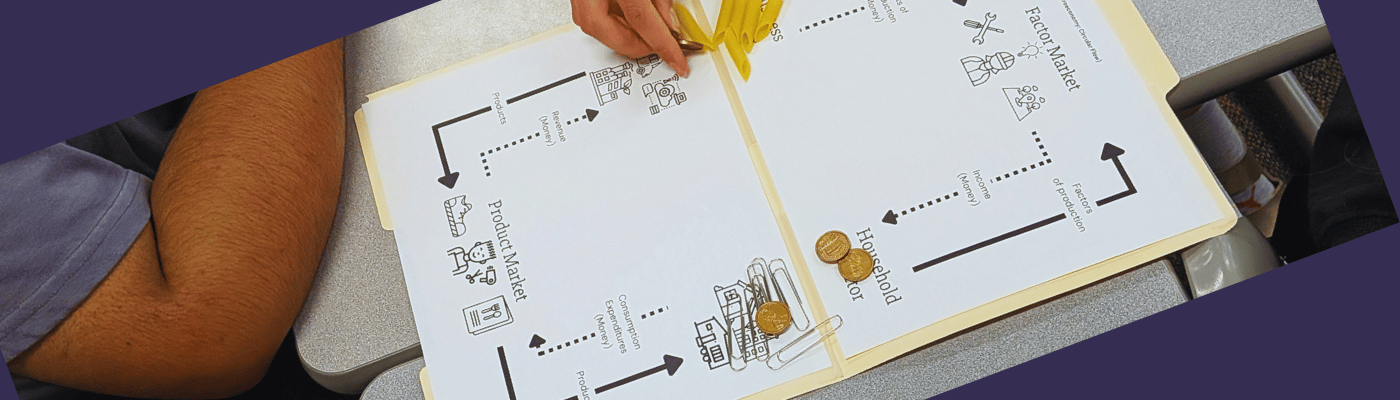
- Circular Flow Board (assembled to form a single board — consider printing on cardstock or taping to the inside of a manila folder for longevity)
- Simulation Pieces: 1 resealable bag per group containing 6 pennies, 6 pieces of penne pasta, and 6 paper clips
- Simulation Instructions (1 copy per group of 3–4 students)
OR - Digital Circular Flow Materials: make a copy for each group of 2–3 students and enable editing access, plus 1 laptop or device per group
- Student Handout (1 copy per student)
- Reinforcement Readings (1 copy per 2 students, cut into thirds)
Optional
- Unit 3 (Macroeconomics) Key Terms (digital access or 1 copy per student)
Lesson Sequence
Slides 2–6
- Place students into groups of 3 or 4 (for the physical kit) or pairs — groups of 3 if needed — (for the digital option). Students should sit facing one another with space for Circular Flow Board in the center.
- Display Slide 2. Distribute 1 copy of Unit 3 Overview: Macroeconomics to each student. Tell students it serves as a roadmap for the unit — it contains all learning objectives and the ongoing summative assessment. Encourage students to place it in their course notebook or another easily accessible location, as it will be referenced throughout Unit 3.
- Proceed to Slide 3 and direct students to discuss the prompt with their group. (Additional educator tips and suggested answers are in the notes section throughout Instruction Slides.) After approximately 2 minutes, call on several students to share their responses.
- Advance to Slide 4. Remind students of the difference between microeconomics and macroeconomics (introduced in Lesson 1.3): in Units 1 and 2 we considered the choices of individual households and firms; in Unit 3 we consider the behavior of all households and all firms.
- Progress to Slide 5. Explain that from this point on, when students encounter the term "the economy" they should understand it refers to the macroeconomy.
- Display Slide 6 and introduce the learning objectives. Explain that students will take part in a simulation to achieve these objectives.
Slides 7–23
- Proceed to Slide 7. Tell students that before the simulation can begin, the class will review basic economic information and go over the instructions.
- Display Slide 8. Tell students that the Circular Flow Board illustrates the most basic version of a circular flow model. Remind students that like all economic models, it presents a simplified version of a complicated system. Describe what the Business Sector, Household Sector, Factor Market, Product Market, and Simulation Pieces represent.
- Advance to Slide 9. Distribute 1 Circular Flow Kit to each group. If using the digital option, give each pair a link to their copy of Digital Circular Flow Materials. Allow approximately 6 minutes for students to complete Steps 1–3 on the slide. Circulate to answer questions and ensure all groups have correctly set up Circular Flow Board.
- Progress through Slides 10–11. Debrief the Pre-Simulation Questions. (See notes section of Instruction Slides for additional explanation.)
- Proceed to Slide 12. Tell students the class will walk through the first scenario together as practice. Read the scenario aloud. Click to model the resulting movement of game pieces on the slide and explain the impact on both sectors. Note: Emphasize that game pieces must always explicitly move through one of the markets on Circular Flow Board. Instruct 1 student in each group to move their pieces to reflect the practice scenario.
- Display Slide 13. Instruct groups to read the scenario, discuss the movements that will occur, and have 1 student move the appropriate pieces along the pathlines to their new locations. After approximately 1 minute, call on a group to explain the movement and reasoning. Emphasize that choices in the business sector affect the household sector and vice versa. Click to reveal the relevant portion of the model and the path of movement.
- Progress through Slides 14–16 and repeat Steps 12–13 for each remaining scenario. Encourage students to take turns moving the game pieces.
- Instruct groups to place Simulation Pieces back in the bag and make a pile of Circular Flow Board, Simulation Instructions, and Simulation Pieces. Collect these materials or have students place them under their desks.
- Proceed to Slide 17. Alert students they will now review the main concepts of the circular flow model. Instruct students to think about the question on the slide as they watch the video clip (~90 seconds). Play the video. Note: The video uses "market for resources" for the factor market and "market for goods and services" for the product market, and includes "entrepreneurial ability" as a factor of production. Allow students a moment to discuss their responses with a peer, then debrief as a class. Pro Tip: It is helpful to assign the full video to absent students and make the link available to all.
- Display Slide 18. Tell students they will apply their understanding of the circular flow model to determine how a shock to the economy would impact both sectors.
- Proceed to Slide 19. Distribute 1 copy of Student Handout to each student. Instruct students to independently consider the questions on the slide, referring to the "Circular Flow Model" on Student Handout. After approximately 2 minutes, click to reveal the orange textbox and allow groups to discuss. Debrief as a class, emphasizing the ripple effect the initial shock has on all sectors. Encourage students to add notes and drawings throughout the remainder of class.
- Proceed to Slide 20. Instruct students to write their own definition of the circular flow model on Student Handout.
- Display Slide 21. Define the circular flow model. Click to reveal the questions and allow students a moment to discuss with a peer. Discuss as a class.
- Display Slide 22. Ask students to rate their current understanding of the circular flow model using the scale on the slide. Tell them to make a mental note of their rating.
- Proceed to Slide 23. Allow students a moment to read the instructions. Provide each student with the Reinforcement Reading that corresponds to their self-rated understanding (e.g., a student who rated their understanding at 2 receives Reinforcement Reading 2). Allow 6 minutes. Circulate to answer questions and offer clarification.
Slides 24–26
- Progress through Slides 24–25. Highlight for students that the important takeaway is the interdependence of households and firms in a macroeconomy — not the specific parts or labels of the circular flow model. Students will not be expected to draw the model from memory but will be expected to explain the concepts embedded in it.
- Proceed to Slide 26. Direct students to get a piece of scratch paper (a half sheet is sufficient). Tell students to write their name and response to the summarizer prompt. Collect summarizers and review for misconceptions or gaps in understanding. Address misconceptions at the start of the next lesson.
Aligned Standards
Voluntary National Content Standards in Economics
What Educators Are Saying
I've taught the Circular Flow about 100 different ways. By manipulating the pieces of the game, students were able to physically see the changes. It worked very well!
This is a great lesson! Having students walk through the circular flow model helps them to understand the interactions.
The reinforcement readings were a perfect length for extension-level students. Positive reactions to the game and the readings — many students commented on how the readings helped them connect and reflect on the activity.