
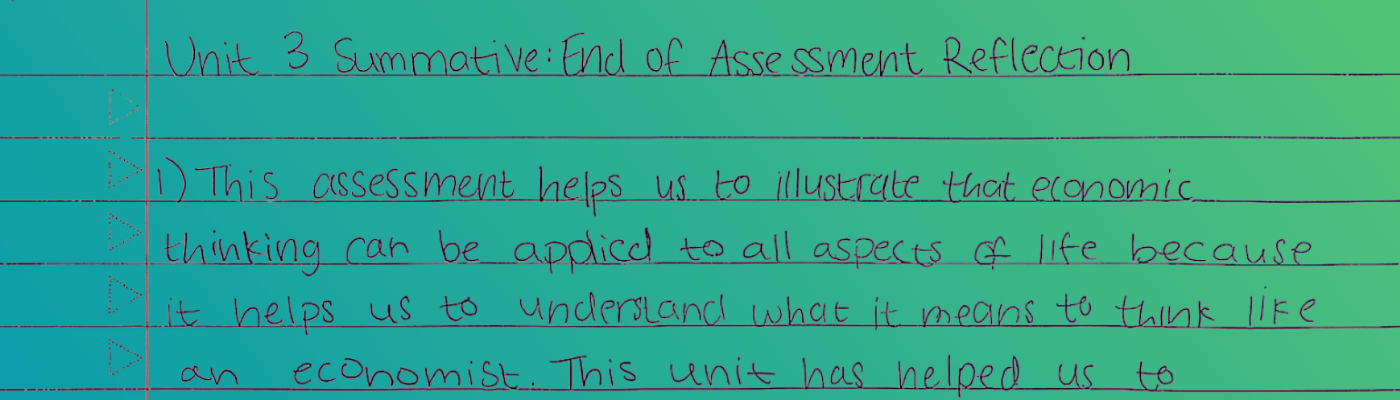
A Practical Guide to the U.S. Economy: Part 4
Unit 3 · Lesson 3.20 · Last updated June 2026
The final assessment day of Unit 3 — students finish Part 3 and any revisions to Parts 1 and 2, then complete Part 4 (Reflection) on their experience thinking like an economist.
Overview
Students complete any remaining portions of Part 3 (Economic Dashboard) and/or final revisions to Parts 1 and 2 of A Practical Guide to the U.S. Economy (introduced and distributed in Lesson 3.2). Students then complete Part 4 (Reflection), responding to two prompts about their experience composing and/or revising the assessment. Note: This lesson assumes students have completed Parts 1 and 2 and have begun Part 3 in Lesson 3.19.
Learning Objectives
- Analyze macroeconomic data to inform personal, professional, and civic decision-making.
- Reflect on your experience completing the assessment.
Create a free account, or log in.
Get full access to materials, the complete lesson sequence, aligned standards, and every lesson across all units.
Already a member? Sign in here.
Materials
- Instruction Slides (display during class period)
- A Practical Guide to the U.S. Economy (previously distributed in Lesson 3.2)
- Printable Student Assessment Template (previously distributed in Lesson 3.19)
OR - Electronic Student Assessment Template (previously distributed in Lesson 3.19) + laptop or device (1 per student)
- Advice Recipients (previously distributed in Lesson 3.19)
Optional
- Additional Advice Recipients (previously distributed in Lesson 3.19)
- Exemplar and Scoring Guide (for educator reference while scoring)
Lesson Sequence
Slides 2–4
- Display Slide 2 and instruct students to follow the instructions on the slide. (Additional educator tips and suggested answers are in the notes section throughout Instruction Slides.)
- Proceed to Slide 3 and introduce the learning objectives for the lesson.
- Proceed to Slide 4. Explain that after 15 minutes of work time, students must submit their completed Part 3 (Economic Dashboard) and any revisions made to Parts 1 and 2.
Slides 5–9 — Part 3 finish + revisions
- Progress through Slides 5–6. Instruct students to reference the reflection rubric on A Practical Guide to the U.S. Economy and explain that it will be used to assess Part 4 (Reflection), in which students respond to 2 reflection prompts about their experience composing and/or revising the assessment.
- Advance through Slides 7–8. Instruct students to continue working on Part 3 (or revisions to Parts 1–2). Redistribute physical copies of Student Assessment Template or instruct students to access their electronic copy. Distribute Advice Recipients to students as needed. Circulate to supervise and clarify as needed.
- Advance to Slide 8 and reinforce that students must locate and analyze recent data for each indicator. Links to FRED® graphs are included in the electronic version of the assessment. If using the printable version, provide access via your LMS or distribute printed data.
- After 15 minutes, instruct students to submit Part 3 and any revised portions of Parts 1–2. If students are submitting revisions, instruct them to also submit the scored rubrics from their initial submissions. Scoring note: Use the "Part 3: Economic Dashboard" rubric from the original distribution of A Practical Guide to the U.S. Economy to score Part 3. Use the "Parts 1 and 2" rubric to rescore any revised portions. (Originally distributed in Lesson 3.2.)
Slides 10–11 — Part 4
- Proceed through Slides 10–11. Instruct students to begin working on Part 4 (Reflection) either in an electronic document or on their own paper. Circulate to supervise and clarify as needed.
- Collect Part 4 of A Practical Guide to the U.S. Economy. Pro Tip: If students completed the assignment electronically, include a copy of the rubric in their document. If students wrote by hand, have them staple the rubric from the original distribution of A Practical Guide to the U.S. Economy to the back of their writing.
- Use the "Part 4: Reflection" rubric on A Practical Guide to the U.S. Economy to score student work.
Aligned Standards
Voluntary National Content Standards in Economics
What Educators Are Saying
Students had a wealth of information to share about their newfound confidence with thinking like an economist. It offered metacognition to reflect on the work they achieved and the improvements they made.
Relevant and simple.
The level of detail, the clarity of the explanations, and the student-centered focus are at the heart of what makes this so effective. The guidance it provides teachers to ensure we're delivering it well is invaluable. It has quite literally been a lifesaver!