
An Introduction to Budgeting
Unit 5 · Lesson 5.8 · Last updated June 2026
A 45-minute stations-based lesson where students learn what a budget is and build a balanced monthly budget that reflects their personal priorities — then put it to the test with an unexpected expense.
Overview
In this lesson, students are introduced to what a budget is and are challenged to create a balanced budget that reflects their priorities in a stations-based activity. Note: The summarizer explicitly connects to the Unit 5 summative assessment introduced in Lesson 5.7; consider revising it if students have not participated in that lesson.
Learning Objectives
- Describe a budget.
- Apply the principles of economic thinking to create a balanced budget.
Create a free account, or log in.
Get full access to materials, the complete lesson sequence, aligned standards, and every lesson across all units.
Already a member? Sign in here.
Materials
- Instruction Slides (display during class period)
- Student Handout (1 copy per student)
- Budget Stations (class set — 1 copy, cut into 9 slips)
OR - Digital Budget Stations (make a copy and provide access as "view only")
- Laptop or device (1 per group of 3 students)
Optional
- Calculator (1 per student)
Lesson Sequence
Slides 2–4
- If using the physical Budget Stations, prior to students entering the room, determine 9 unique locations to place each station. Position stations numerically for easy rotation. If using Digital Budget Stations, secure devices for students.
- Display Slide 2. Distribute 1 copy of Student Handout to each student. Tell students to follow the instructions on the slide. Allow students approximately 3 minutes to complete the steps. (Additional educator tips and suggested answers are in the notes section throughout Instruction Slides.)
- Progress through Slides 3–4. Explain the learning objectives for students and acknowledge that today's lesson will present simplified budgeting circumstances.
Slides 5–17
- Proceed through Slides 5–6. Use the text on Slide 6 to define a budget.
- Advance to Slide 7. Tell students to discuss the question on the slide with a peer. Click to reveal the orange textbox and ask several students to share their responses with the class.
- Display Slide 8. Use the text on the slide to reinforce the importance of using net pay when building a budget.
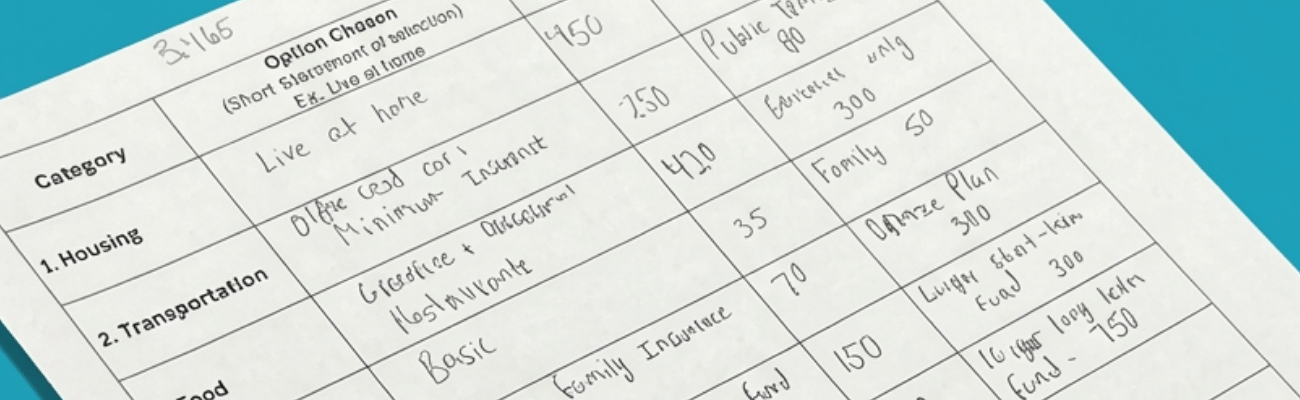
- Proceed to Slide 9. Direct students' attention to the "Build Your Monthly Budget" portion of their handout and allow students 3 minutes to read the text.
- Display Slide 10. Use the text on the slide to reinforce the goal of the budgeting activity and what it means to have a balanced budget.
- Advance to Slide 11. Explain the mechanics of the activity using the information and example on the slide.
- Proceed through Slides 12–13. Reinforce the importance of considering individual priorities and preferences when building a budget. Allow students a moment to reflect on their priorities.
- Advance to Slide 14. Pause to allow students to discuss their responses to the questions. Click to reveal the correct responses on Slide 15. Answer any remaining questions related to the budget activity.
- Indicate the location of each Budget Station in numerical order in a clockwise fashion. If using Digital Budget Stations, open and demonstrate how to navigate the slides in "Slideshow" mode. Allow groups approximately 27 minutes to virtually "visit" each station. Skip to Step 16.
- Display Slide 16. Divide the class into 9 groups and assign each group a unique starting station. Direct students to begin with the station assigned to them. Allow groups 2 to 3 minutes to review their first station and record their selection and opportunity cost on Student Handout. Circulate to answer questions as needed.
- After 2 to 3 minutes, direct students to rotate in a clockwise fashion to the next sequential station. (Students at Station 1 proceed to Station 2 and so on; students at Station 9 proceed to Station 1.) Repeat until all groups have reviewed all 9 stations and achieved a balanced budget, or 27 minutes have passed.
- Proceed to Slide 17. Instruct all students to return to their desks and make their final calculations.
Slides 18–33
- Progress through Slides 18–19. Use the text on Slide 19 to frame expectations for the upcoming debrief.
- Advance through Slides 20–21. Allow students a moment to discuss their thoughts in small groups. After approximately 1 minute, call on several students to share with the class. Click to reveal the text on each slide and add to student responses as needed (see the notes section of Instruction Slides for further explanation).
- Display Slide 22. Acknowledge that life is full of unexpected events and that a robust budget should have some flexibility to manage the unexpected.
- Proceed through Slides 23–24. Tell students they will encounter an unexpected event and test their budget. Call on a volunteer to select a number from the list on Slide 24.
- Click to reveal all possible options on Slide 24. Click on the number of the event the volunteer selected. (Doing so will take you to a slide with details about that unexpected event.)
- Read aloud the details of the unexpected event selected by your volunteer.
- Click on the "Let's Discuss" button on the slide to advance to Slide 33. Allow students a moment to discuss the questions on Slide 33 with a partner. Then call on several students to share their responses with the class.
Slides 34–35
- Proceed through Slides 34–35. Use the text on Slide 35 to remind students what the focus of the end-of-unit summative assessment is. Click to reveal the question on the slide and tell students to discuss their responses with a peer. If time permits, call on several students to share their responses with the class.
Aligned Standards
National Standards for Personal Financial Education
What Educators Are Saying
I liked how this lesson had real life applications and costs. The students could really understand how budgeting works and how much things will cost once they start adulting. The students were talking to one another and comparing their budgets. It became a contest to see who could save the most money!
The lesson included realistic options. The unexpected expense section led to some good discussion about what kinds of expenses occur unexpectedly and how to try to plan for those.
Valuable lesson for students to keep in mind as they move towards being more independent.